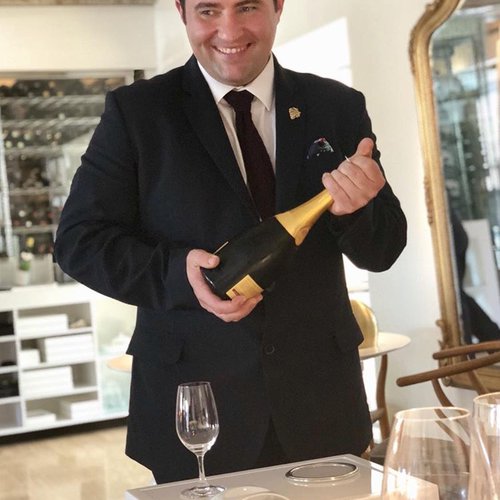
"Cava is an ace up your sleeve" Silvia Ortúnez, head sommelier at The Library
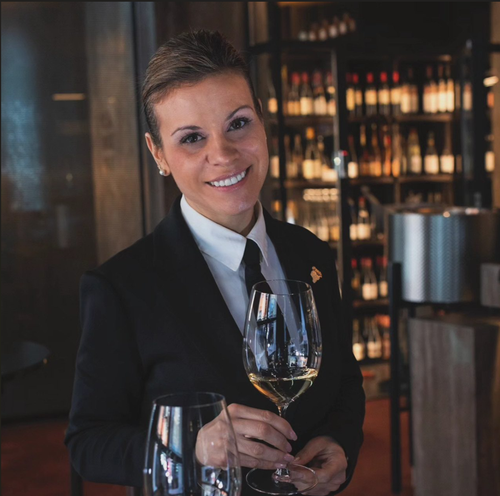
She entered the hospitality industry in a baby stroller, as her mother and siblings ran a bar in Olmedo because her father, a truck driver, had fallen ill. Everyone had to pitch in. Sommelier Silvia Ortúñez, who now heads The Library in Madrid, along with a great team, began her career in the family business, which diversified over the years. Silvia's curiosity, however, was focused on a different horizon: "I read in the newspaper that they were offering a course on wine, and I signed up," she recalls with the drive and verve that define her. "Being a hostess makes me happy; I think it's important to provide good service and for the diner to enjoy themselves. Back then, in Valladolid, telling the difference between whites, rosés, and reds, and still and sparkling, just wasn't enough. I've been learning about wine ever since I took that course, I haven't stopped," she explains. She has a way with people and really enjoys the act of sharing. Just over five years ago, she made the move to the capital, seizing the first opportunity she was offered to work as a sommelier at Berria. Then she joined Kabuki as Head Sommelier, and now she holds the same position at The Library. In 2024 she won a Verema Award for Best Sommelier in Spain. Her meteoric rise is the result of hard work, tenacity, and strong convictions, all infused with dreams and a beautiful, infectious smile. With regards to Cava, she says, "It's always an ace up your sleeve." The moment when she, personally, most enjoys it: over a leisurely conversation. She celebrates all the nuances it offers today, taking into account its aging, styles, regions, and varieties. She highlights the vibrancy of the younger wines and the serenity of those that have been aged for many years. She selects them according to the occasion. She champions them, and serves them as just another type of wine. At The Library, she has no shortage of opportunities to do so.
From a family project in Valladolid to the capital. How did the journey unfold?
We are three siblings, and, in addition to the hospitality business, when my father recovered, we opened a beverage distribution company. We diversified the business. I was already captivated by the world of wine, and I never stopped learning; I took many courses related to it. In fact, people even asked me if that was all I did: continue my education. The idea was always to grow and scale up, little by little. On one of my wild wine-related trips, I met the sommelier Tomás Ucha, who was at Berria and is now at Diverxo. I told him, half in jest, that I would go and polish his glasses, just like that. Shortly afterward, he offered me a job, and I said yes right away. Before I knew it, I was living in Madrid.
Everything has happened in a very short time. What have you learned over the past few years?
I remind myself that my job is to work with wine, and with customers. It's a world where you have to share, which goes beyond just serving. The magic of being a sommelier is reading situations, the dance of the service — you blend into the background, then you offer, you recommend… But when I arrived in Madrid, it wasn't easy for me. Not long after that they offered me the position of Head Sommelier at Kabuki, and I said yes again. You sign up for everything when you have a dream. I spent two years there, after it opened. They were tough, but I learned a lot, and I made friends there, some of whom are now family.
And then came the offer from The Library, a completely new concept related to wine…
It was hard for me to make up my mind, but I saw a great opportunity to learn, to improve, to create something interesting, and here I am again. I see it as a challenge, because even I didn't really realize that the place belonged to the Paraguas group. I am fascinated by their commitment to respect and responsibility for the wine itself, and they seem to me to be a clear example of how to take the utmost care of it. We buy wine in large quantities, but the traceability is the most thorough I've ever seen. The wines arrive at the winery from the central warehouse with great care, and this marks a very significant turning point. And a great learning experience as well.
For those who aren't familiar with the concept, what is The Library?
It's a three-in-one, or rather, a four-in-one: a wine bar, a restaurant, a boutique shop, and a members' club that hosts private tastings for its members. We say it's a place that pays tribute to wine and to those who know how to enjoy it.
Your role is to coordinate and manage all of these areas.
I always carry an opener with me. Club members receive ongoing guidance from the team. We share the work, and I enjoy approaching anyone at the shop, the wine bar, or the restaurant. You learn something from everyone and from every role, and one great thing is the access we have to certain wines. I think the most important thing is to always make the other person happy, and grateful to you.
What role does Cava play at this temple of wine?
Bubbles are always good. That's my motto. I love bubbles. I'll tell you, on my first day at Berria, I didn't recognize David Aura, from Cavas Mestres, and served him one of his own wines. It was funny after I got over the trauma. For me, sparkling wines are happiness; they're an ace up my sleeve. At Kabuki, I valued them from day one. They gave me a whole range of culinary options to play with. And I think that at The Library, they're also the common thread in a pairing meal at the restaurant. Cava can be a zero-km product, and a beverage that lets you switch gears. Sparkling wine is wonderful.
What's your favorite time to enjoy it?
Over a long chat. It's always perfect for that. It’s well-behaved. And it aids digestion, as some producers often remind me. Plus, there's the peace of mind that comes with a long aging process. I think the diversity within Cava is truly remarkable, not only in terms of regions, but also in terms of aging, grape varieties, production methods, and styles, all within the traditional method.
Have you managed to promote these aspects beyond celebratory occasions?
Many people still view sparkling wine as a luxury or something for celebrations, but as sommeliers, we consider it just another type of wine that can be enjoyed on many more occasions. A young Cava without much complexity is ideal for an evening out. A more creamy, more complex, more intense sparkling wine… can complement a different occasion with a more sophisticated culinary offering. It's like getting dressed: you get up in a more comfortable style, and you can end the day in a different, more festive one. I believe that sparkling wine can be enjoyed in a wide range of occasions, and you have to learn how to enjoy it.
In what way?
It's not just a thirst quencher; you have to educate the diner, anticipate what their palate is going to experience. You have to read each person—whether they're in a hurry or not—and give them water right away. You need to know that they might have arrived at The Library feeling hot, that they might have had trouble finding a parking spot… Right from the start, they won't accept a Cava or a beer; you have to give them some leeway and quench their thirst.
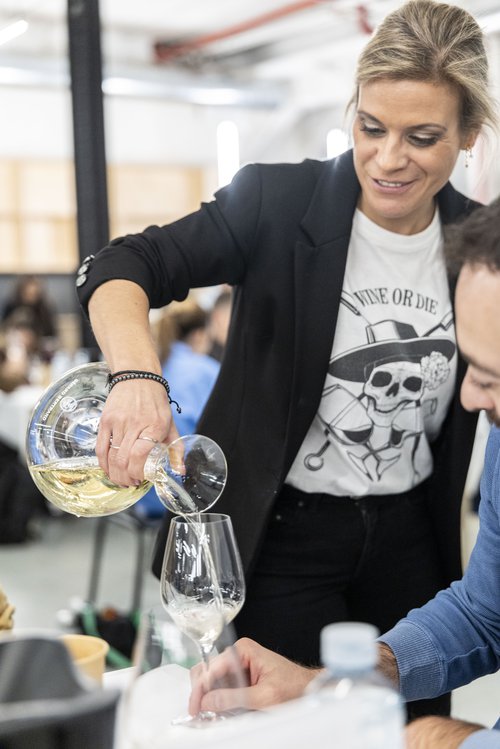
You have to practice the ritual and discover the texture…
Well, when I lead tastings or host presentations I offer some recommendations in this regard. First, I suggest taking a small sip. Swirling it around in your mouth, connecting your pH with that of the wine; it's like a quick conversation. Your palate is asleep, and so are your taste buds, and suddenly you're presented with a food that has an acidity and bitterness that you probably haven't identified… First, we need to calm down. People don't like beer or sushi the first time they try them. One has to get used to experiencing unnatural sensations… Also, depending on the country you're from, you'll find it easier to like one food or another. My trick is to ask about coffee, how they drink it. Black, with a lot of sugar, or a little, long, with milk… That gives me a clue as to which style of wine might suit them.
If I say Penedès, what do you picture?
An oasis. I was in Massís del Garraf just before the last Barcelona Wine Week, and I had that feeling. I went from calm to the hustle and bustle of the city. I'm eager to go back to Penedès and learn more, to delve deeper. Over the past five or six years, I've been too focused on work and haven't been able to travel, but I have plans in mind, and I hope it won't be long before I can make them happen.
The Library might seem a bit sophisticated—is it really for everyone?
Its aim is to democratize wine consumption. I sincerely believe that it's a place that every wine lover should visit. You have access to complex, hard-to-find labels, and there's always a lot of movement, a lot of coming and going. We have 2,600 bottles on hand, but the group can offer you up to 4,000, and, in half an hour, they can bring the bottle you need to the store. There's a very significant collection of vintage wines…
But, is it affordable?
On my first day of work I confirmed that I could sit down and share a bottle with my friends, whereas before I had to kill myself just to get two bottles of the same label through work. Our prices are competitive, and the mark-ups aren't crazy. But you do have to keep in mind that you're on the Calle Serrano number 2 in Madrid. You can buy it or take it home. And I would say that it's a real treat to be able to purchase certain bottles that customers from all over the world ask us for, and to send them those bottles. It's true that the place can be a bit daunting visually, and that on some days there's a line to get a drink, but that doesn't mean it's not a place that encourages, precisely, wine consumption.
Do members let you make recommendations?
The members are clear about what they want, but despite that, they listen to you. It's a challenge to source, but that's what it's all about.
Is it more intimidating to have a demanding winemaker or a demanding customer sitting across from you?
They don't intimidate me; I've forced myself to be myself. I don't try to impress them with things that haven't impressed me. You can't impress someone with a Barolo or a €1,000 bottle. Where's the magic there? What really defines me is my identity, being natural, and offering what my instincts tell me to at that moment. I always see three scenarios: serve what you want, serve what you like, or serve what I think could be a discovery. I don't look for complexity; I want the customer to win — if that means I lose, so be it.
What you describe is generous and very honest on your part. It also exudes humility, which is essential in the role of a sommelier.
I like wine to be seen as something special, as a surprise, for people to discover the human history and the landscape conservation behind it, and for there to be openness. I don't want to fail as a server, and that's how I understand service: with a very great responsibility, because you have to respect the producer and make every effort to present the wine and please the customer.
Satisfying and respecting are not easy.
My goal in life is for people to want to keep drinking and toasting with me, both personally and professionally. In my line of work, the right thing to do is to give. If you also receive, that's great.
What have you learned from your family, with whom you started out in the trade?
I'll tell you, my father, who taught me to drive, always told me, "If you're going to pass someone, do it; if you're not sure, don't even try." And I apply that in my work every day when it comes to choosing a wine. Maybe it's not the wine of their dreams, but it's the wine that helps me prove that there's something special in that bottle. The one you choose without hesitation is going to be the best, and the best story. And, if you fail, you always have another chance—you can fall, get up, and try again.
When you were named Verema's Sommelier of the Year in 2024, what happened?
You have to keep improving every day; each service is a new challenge. You have to get up excited and come to work with a smile. And, at night, you're exhausted but happy, because you've served wonderful wines or met a new customer. And you want them to come back. It's happiness and a great responsibility at the same time.