"Cava plays a chameleon-like role" José Antonio Navarrete, Sommelier and Manager, Quique Dacosta Restaurante
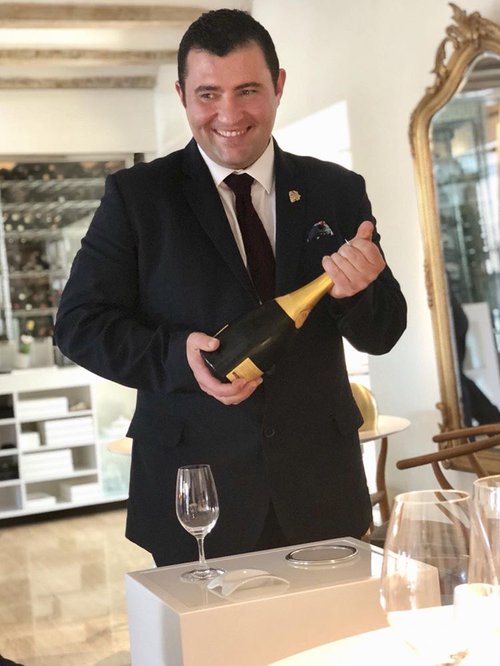
He studied optics and optometry because it promised job opportunities – "It's nice to make money, that's the way capitalism is," he laments, but what really mattered was that his degree made his mother happy. José Antonio Navarrete, born in Moratalla, Murcia, soon became as interested in the sense of smell as he was in the sense of sight, if not more so. Today, he is the manager and head sommelier at the Quique Dacosta Restaurante in Denia. Through wine, for over twenty years he has been fueling the culinary and artistic creativity of a chef, someone who is now a friend and who praises him effusively on social media: "Navarrete is part of our culinary heritage." He recognizes that, at first, the chef was unable to sign him on; José Antonio didn't accept Dacosta's offer until a year after meeting him, when, during a chance encounter, he saw in him a demanding and determined individual. He enjoys challenges and knows that excellence lies in seeing to every little detail. In 2012 he was named Best Sommelier at the National Gastronomy Awards. That was a shot in the arm, but also a responsibility that he has shouldered every day since then. He is a discerning sommelier, attentive to vintages and textures, and his language is both poetic and sharp. He is passionate about service, which he learned about during his short time at Can Fabes in Barcelona.
The wine list has surged in both size and value. It has evolved, just as he has. He continues to enrich it with increasingly authentic and independent voices. Cava plays a prominent role. For Navarrete, Cava is not just about excitement and celebrations; he also sees it as a drink of silence and respect ― the same kind he has for his profession and his colleagues.
How does an optician become a sommelier?
In high school, they gave us talks about career options, and, as you know, our society has a problem: it focuses on money rather than on what you like, what excites you. That's why I studied optics and optometry. Before I became a sommelier, I made my mother happy by finishing my studies. There weren't any opticians in my town, so it was a career with good prospects. In my second year, I started looking for a job to become financially independent, and that's how I was exposed to the restaurant industry. I'm a disciplined person, and at El Rincón de Pepe I started organizing the wines by color. The maître d' told me that was not a professional classification method, and he encouraged me to expand my knowledge by putting me in touch with the Murcia Sommelier Association. José Picón Ruiz sparked my curiosity to learn and to explore, and that's where it all began.
Your résumé includes a stint at the legendary Can Fabes, Santi Santamaría's culinary temple. What did you learn there?
Every restaurant where I've worked has taught me something. You don't learn about wine; it teaches you. At Can Fabes there was an emphasis on a love for the customer, the dining experience, and service. At all of Santi's restaurants, great care was taken over every detail. Perhaps the big difference between a good restaurant and a very good one is a sum of many small details.
What were your first encounters with Quique Dacosta like?
November will mark twenty-one years since we started our journey together. I ate at El Poblet twice; I liked the cuisine there. There was an initial opportunity to work together, but I didn't see myself there at the time. We met again later, at Gastronomika in San Sebastián. Quique gave a talk on rice and aloe vera. We ran into each other by chance, and he asked me again. A year had passed since we first met. That's when I said yes. The restaurant already had a Michelin star, and he was clear on the need to improve in terms of service and wine. He likes things done right away, and that motivated me. At the time, I came from a place where there was a lot of complacency, but I'm one of those people who believe, like Quique, that you can always grow and make more progress.
Quite a challenge...
There was a lot to do. At the time, the wine list was short and disorganized because no real thought had been given to it, and the dining room needed to grow. Just one year later, we already had our second Michelin star, and six years after that, we received our third. For me, however, the most important thing was that all of this was the fruit of what was happening inside. We started to have a team, specialized glassware… A cellar with three distinct spaces. We went from a wine list of 300 items to 2,500, with 12,000 bottles… This evolution wasn't as visible, but it was crucial to building our reputation.
The team also evolved.
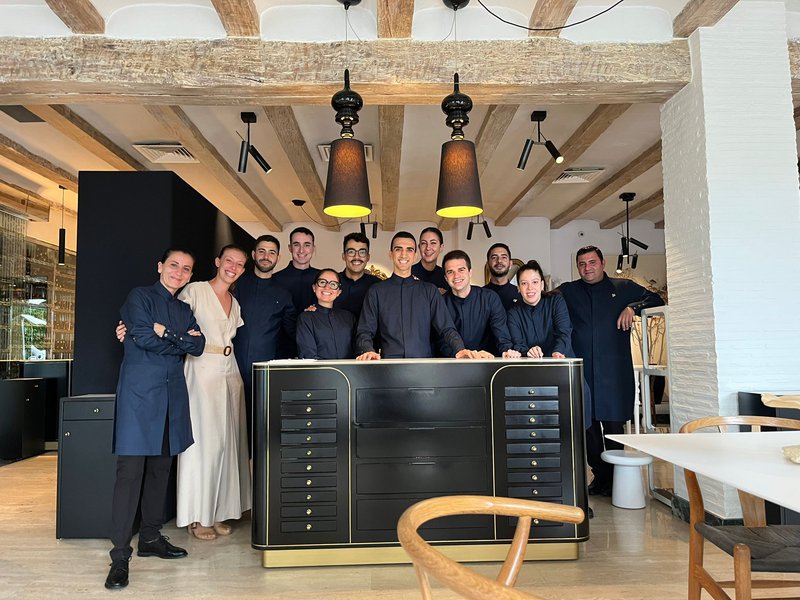
Of course. I started out as a sommelier, and at first there were just two of us. Today, there are four people on the team. We have increased our service capacity, our team has grown, and we've been reducing the number of customers per service. As for me, over these two decades I have, without a doubt, grown, both personally and professionally. Now, I'm the restaurant's head sommelier and the manager. I don't know if that's a natural progression, but when you spend over twenty years in the same place, you realize that the person running it needs to be someone who has been involved in everything that's been created and who knows how it all works.
A wine list is about more than just the wine; there are also values and principles. It also has its own DNA. What is yours?
It's a living list, because the wine world is a living thing. There are wines that I like today because of the vintage, but maybe next year they won't impress me. Wines' profiles change, just like we do. I don't taste wine the same way I did when I was twenty. My knowledge has expanded too; I couldn't have had certain wines back then because I didn't know about them. The second key is that our wine list is linked to our cuisine. We're in the Mediterranean, and the wines reflect that. And then, it's a list that reflects what's happening in the world; changes in style, in varieties, and so on.
And, what is happening in the world today, José Antonio?
Well, there's a silent revolution. More and more people are using authenticity and freedom to tell the story of a landscape, translating it into liquid form. The revolution that took place in the culinary world ten or fifteen years ago is now happening in the world of wine. There are more and more perspectives on the same terroir and the same variety, and that enriches the product because there is less of a focus on cookie-cutter uniformity.
The same thing is happening in the world of sparkling wines.
Over the past 15 years the Champagne landscape has changed dramatically. The percentages of big houses on wine lists have dropped because small winegrowers and vignerons have joined the scene, relying not on marketing, but on the power of their vineyards and their voices.
Is the same thing happening with Cava?
I think that's the next step we're going to see. The story is not being told just by the big companies whose products we have enjoyed up to now, but also by smaller ones. I think restaurants and consumers are going to turn their attention to them; in fact, we already are.
What value does Cava add to your wine list?
If there's one thing that defines sparkling wines, it's that message of happiness. When we talk about sorrow, we think of an aged Sherry. When we talk about emotion, happiness, and excitement, we think of sparkling wine. At Quique Dacosta, sparkling wine plays a role at different times. The first moment comes at the start, in the garden, where we serve an aperitif with three or four small appetizers. These are paired with a Cava or a Champagne because of their versatility, their dynamism, and the way the wine complements the different tastes, flavors, and textures we offer.
Their prominence on the wine list is also important.
Sparkling wines make up 10% of the 28,000 labels we offer. Sparkling and white wines have always been significant, and we can now confirm that they have surpassed the reds. We are located in Denia, close to the sea and to the plant and marine worlds, so their dynamism makes them essential on our list. What's more, Cava has a quality that pairs well with dishes from start to finish. It has a chameleon-like quality that is not always found in white wine.
What do you think of the Cava trend we are seeing towards long aging and organic production in the Guarda Superior category?
Overall, it's positive, but I should point out that it isn't always. Not all wines can be aged for long periods simply to gain status or classification. Just as not all vineyards are suitable for producing a classified wine or a Grand Cru, the same is true for long-term aging. Only great wines from great vineyards and great vintages can undergo long-term aging. I agree that the potential and quality of the wine, in relation to its aging, is a factor to consider.
When Quique Dacosta posts on social media that Navarrete is a "part of our culinary heritage," how do you feel?
Deeply moved. Our relationship far transcends the professional sphere. I don't think of him as my boss, and I don't think he thinks of me as his employee. But for someone as important as him to say that about me, well, that really moves me.
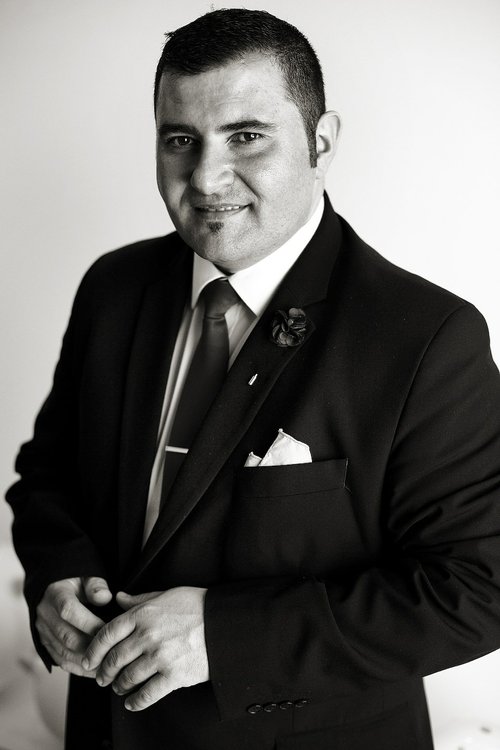
People often compare you to Josep Roca, not only because of your in-depth knowledge of the world of wine, but also because of your precise and poetic language.
I'm not a football fan, but I draw on it for analogies. Being fortunate enough to know a Messi, and having been able to learn from him, is a truly great thing. For me, Pitu Roca remains a great role model, especially for his values. I think we are all combinations of many influences and things. If I resemble him in any way, I'm content. I am grateful, though, for the values I was taught at home: loyalty, hard work, and respect. The world of wine is, after all, a landscape painted by many people, and the many people I have encountered over all these years in the trade are my grape varieties. Some are village wines; others are Premier Cru; and then there's Pitu — a Grand Cru. I've been fortunate enough to share the same time and space with him in the world of gastronomy.
In 2012 you received the Best Sommelier Award at the National Gastronomy Awards. Looking back, do you see that as a turning point in your professional career?
Awards are a result of the work you are doing. Honestly, I accepted the award with a great sense of responsibility, especially because it gave a voice to the people who are there, every day, around me, supporting me quietly, and who I represent. I carry that responsibility with me every day, along with a deep sense of gratitude.
When does José Antonio Navarrete enjoy Cava?
At many times. Because it's part of moments of celebration, but also ones of refuge, silence, and concentration. And I often choose it when I don't know what to drink. It's also a wine for quiet moments, and a safe bet.
As you're a keen reader, I'm sure you also enjoy it with a book. What are you currently reading?
Normally, three things. One is always related to wine ― specialized magazines. I read about the industry every day, and I combine that with two other books. One that I feel like reading, related to my profession, and another that has nothing to do with it. I was at Château Rayas three days ago and bought the book they just published, written by Laure Gasparotto and Jérôme Neutres. And I also finished Comerás flores by Lucía Solla. Reading helps me escape from what I spend most of the day thinking about, which is wine, food, and the restaurant. That is, if I'm not traveling. I was in Châteauneuf-du-Pape a few days ago, and I'll be back in Burgundy in no time.